
The fisheries sector is vital in India as an important sector for providing livelihoods to hundreds of millions, ensuring food security, supporting coastal economies, and boosting rural incomes. It was in realisation of this potential that the Government of India decided to introduce Pradhan Mantri Matsya Sampada Yojana- a bold, ambitious and comprehensive scheme to bring about a blue revolution through the sustainable development of the fisheries and aquaculture sector in the country. It aims to ignite a “Blue Revolution” with a strategy that is multi–pronged and involves a staggering scale of investment: providing more fish production, infrastructure, value chains, securing fisher incomes and creating employment. This article discusses the context, objectives, framework, successes and constraints of Pradhan Mantri Matsya Sampada Yojana and also examines whether it can re-establish an integrated fisheries value chain of future India.
Need For PM-Matsya Sampada Yojana: Background
India, with a large and historical fisheries sector, was beset at the time of PMMSY with structural deficiencies, which included:
Low Productivity And Primitive Fishing/Aquaculture Methods. Use of modern water management (flood control, seed farms, hatcheries, aeration) and scientific aquaculture practices is limited.
Significant Post-Harvest Losses Post-harvest losses, in both fish and crops, become wasted harvests without cold storage or preservation, and poor supply chain management means the profits go to the intermediary traders and not the fishers or farmers.
Minimal value addition – most of the fish caught were sold in raw form, without any processing, packaging or export viability.
Darwish’s description of an insufficient support network in general, fishers had limited access to credit, insurance, modern inputs, or training.
Underexploited potential for exporting and generating foreign exchange from fisheries products, processed fish, ornamental aquaculture and value-added marine resources.
Millions of fishers, fish farmers and allied workers, especially in coastal and rural parts, where alternate livelihood options were few, needed livelihood security.
Pradhan Mantri Matsya Sampada Yojana – Overview
PMMSY is a flagship scheme for the development of fisheries and is a joint venture of the Government of India. The Union Budget 2019–20 had announced the scheme via the Finance Minister, with a view to developing a comprehensive framework to fill the infrastructure gaps in fisheries, modernise fishing and aquaculture practices and double the production and value addition at a faster rate of growth for inland and marine fisheries.
The scheme foresees applying a new Fund ₹20,050 crore ($27.36 billion) outlay, the biggest investment in fisheries in India to date.
It is about growing and sustaining fish production, enhancing post-harvest infrastructure and value chains, minimising waste, increasing incomes for fishers and fish farmers, and generating jobs throughout the sector.
An umbrella scheme, it will encompass inland and marine fisheries, aquaculture, value-chain development in fisheries, marketing, exports, infrastructure and welfare of fisher communities.
Important Goals of Pradhan Mantri Matsya Sampada Yojana
Unlock the sustainable potential of fisheries, sustainable, responsible, inclusive and equitable use of water and land resources.
Increase production and productivity of Fish through expansion of aquaculture, quality seed, water management, scientific fish farming, cage culture, recirculatory systems, etc.
Constructing ports, cold storage, processing plants, transportation, marketing and export-ready facilities to minimise loss, maintain quality and provide additional value.
Incentives for doubling the incomes of fishers and fish farmers include subsidies, credit support, insurance cover, training and market linkage.
Will create direct and indirect employment opportunities at the level of fish farming, fish processing, marketing and allied services in lakhs across the country.
Enhance the share of fisheries in national GVA and exports by value addition in fish production at all levels with improved and value-added exit quality of seafood& aquaculture products.
Protect fisher communities through measures of institutional support, insurance, access to credit, livelihoods support, and fisher-friendly infrastructure, for their welfare and social security.
Encouragement of sustainability, traceability and control and notification, enhancement of fisheries management frameworks, modern aquaculture practices (Biofloc, Recirculatory Aquaculture Systems (RAS), aquaponics, genetic improvement and sustainable fishing standards)
Pradhan Mantri Matsya Sampada Yojana Structure & Components
To meet these goals, the Pradhan Mantri Matsya Sampada Yojana is planned in a two-component umbrella scheme as follows:-
- The Central Sector Scheme (CS) includes all activities which are fully funded and implemented by the Central Government (including ministries). This caters for national-level infrastructure, costly establishments, deep-sea fishing support, large harbours, export-oriented processing units, research and development, technology demonstration, and mega aquaculture initiatives.
- Centrally Sponsored Scheme for Inland Fisheries and Aquaculture (CSS): Implemented by states/UTs in a sharing pattern between Centre and State for development of fish farms, small aquaculture units, community-based local harbours/landing centres, cold storage, small-scale processing and community-level interventions.
PMMSY, under these components, promotes the following diverse sub-activities:
Expansion of inland aquaculture in ponds, tanks, reservoirs, and cages.
Fish seed production hatcheries and nurseries; seed supply strengthening.
Modernisation of the marine fishing fleet, deep-sea fishing support, including safer boats, vessel insurance, fishing harbours, landing centres, and fishers’ welfare.
Establishment of post-harvest infrastructure, e.g. cold storages, processing units, packaging, transport to minimise losses and extend shelf-life.
Value addition, export facilitation, regulatory compliance, traceability
Welfare measures: insurance, credit linkage and Social security of fishers and fish farmers.
And expensive fish farming practices & commercial aquaculture development are critical for modern aquaculture, capacity building, training, technical upgradation, modern aquaculture practices (Recirculatory 83; Recirculatory aquaculture systems (RAS), aquaponics), and sustainable fisheries management plan.
Inclusion of Fisher Farmer Producer Organisations(FFPOs), cooperatives, micro and small enterprises, women-led fisheries projects and promotion of inclusive development, particularly for marginalised fisher communities;
Pradhan Mantri Matsya Sampada Yojana (PMMSY): Targets and Achievements
The government has established ambitious targets for 2020–21 to 2024–25 (later extended in some contexts) under Pradhan Mantri Matsya Sampada Yojana. Here are many key targets:
- Raising national fish production from around 13.75 million metric tonnes (2018-19) to about 22 million metric tonnes in 2024-25.
- Increasing the productivity of aquaculture to 5 tonnes/hectare against a national average of approximately 3 tonnes/hectare.
- Raising per capita fish consumption from roughly 5–6 kg to around 12 kg, enhancing local nutrition and food security;
- An increase in yields, direct market access, subsidies and value addition can actually double the incomes of fishers and fish farmers.
- By investing in cold-chains, processing and storage infrastructure, postharvest losses typically 20–25% in earlier years to around 10%.
- Creating approximately 55 lakh (5.5 million) direct & indirect employment in fisheries, aquaculture, processing, logistics, exports & ancillary sectors
- Enhancing the role of the fisheries sector in the national Agricultural Gross Value Added, foreign exchange earnings, export growth, and rural livelihoods: Fisheries Policy Objectives
Also Read : Pradhan Mantri Garib Kalyan Anna Yojana| मुख्यमंत्री चिरंजीवी योजना
Achievements & Progress So Far
- Pradhan Mantri Matsya Sampada Yojana has made a good start as a scheme (though the promise is yet to be fulfilled). Some important achievements:
- The record investment of ₹20,050 crore mobilised under the scheme is the highest for fisheries to date.
- Take up across states and union territories: PMMSY is being implemented in all the states & UTs, and PMMSY is also covering inland fisheries, marine fisheries, aquaculture, fish processing and export infrastructure.
- Increasing adoption of aquaculture: More and more fish farmers have started using modern fish farming technologies, such as pond development, cage culture, hatchery, and better seed , to realise higher yield per hectare.
- The establishment of cold storage units, processing plants, landing centres and better marketing networks has diminished waste, extending the reach of the market.
Increase in employment & income: benefits, subsidies, credit and support to fishers and fish farmers — including women, small-scale and marginalised communities — to stabilise income and livelihood.
Institutional Mechanism (Formalisation & Institutional Support) • FFPOs/Cooperative Societies are encouraged to improve Bargaining Power, Collective Marketing, Additional Support and improved Regulatory Compliance.
Focus on modernisation and sustainability: Introduction and promotion of sustainable aquaculture practices like Biofloc, Recirculatory Aquaculture Systems (RAS), aquaponics and integrated water resource management, increasing yield with reduced environmental impact.
These steps highlight that PMMSY is not simply a document on paper but is actually transforming infrastructure, technology, livelihoods, and value chains related to fishing and aquaculture across dryland and wetland India.
Targeted beneficiaries under Pradhan Mantri Matsya Sampada Yojana
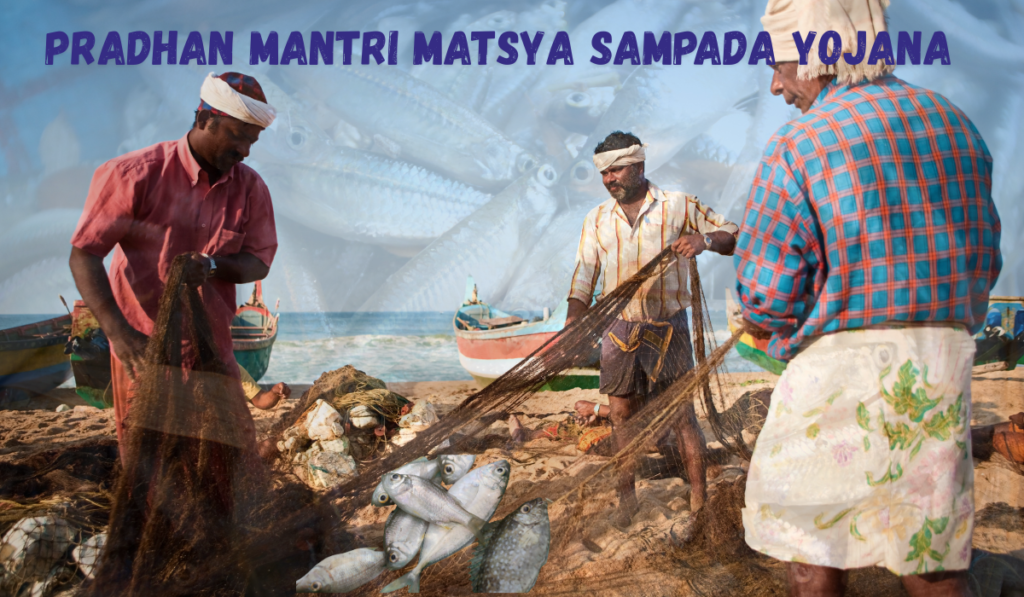
Pradhan Mantri Matsya Sampada Yojana High scope and many beneficiaries. As PMMSY has a broad ambit, many stakeholders are eligible and in a position to benefit. These include:
Capture: Traditional fishers and coastal fishing communities (marine & inland) fishermen using boats, nets and small-scale traditional vessels.
Aquaculture practitioners with one or more of the following profiles either pond owners, cage cultivators, hatchery operators, seed producers, inland fish farmers, reservoir/tank-based aquaculture practitioners
All fish workers, from cleaning and processing to packaging, cold-storage, transport and marketing people, vendors and marketers along the fish supply chain. The supply chain starts at the issuer level and ends with retail and wholesale distribution.
PMMSY also provides special support and assistance for women, SC/ST, differently-abled and marginalised sections involved in fisheries to ensure inclusive benefits.
Please do not change the text belowSmall and micro enterprises, entrepreneurs, aquaculture start-ups, processing units, value-added seafood products, exports, inland aquaculture, fish feed production and other allied activities.
Implementing agency of inland fisheries development, benefit distribution, infrastructure implementation, cold-chain establishment and regulatory framework management, including support for States & UTs governments
As such, the PMMSY is an all-inclusive, equitable and much broader scheme which would benefit from Individual fishers to large-scale entrepreneurs.
Implementation & Institutional Mechanism
Institutional Framework-The PMMSY has a general institutional framework for ensuring effective, transparent and large-scale implementation, which is as under:
Nodal Ministry: The implementation of the scheme is under the Ministry of Fisheries, Animal Husbandry & Dairying (Government of India).
Nodal agency: National Fisheries Development Board (NFDB, which often deals with coordinating & monitoring larger projects, training, capacity building & other central-sector components.
State & District-level units CSS components are implemented on the ground by the State Fisheries Departments at the State-level and District Fisheries Offices, Sub-district Programme Units at the District-level, which process proposals, disburse subsidies and monitor progress.
Establishing Fish Farmer Producer Organisations (FFPOs), cooperatives and community groups needing promotion to help institutionalise fish farmers for collective action and facilitate access to credit, market linkages and economies of scale.
New initiatives/campaigns/ sub-schemes: For example, a sub-scheme, Pradhan Mantri Matsya Kisan Samridhi Sah‑Yojana (PM-MKSSY), was approved, given funding for 4 years in 2024 for the formalisation of micro and small fisheries enterprises as a part of PMMSY.
Technology, innovation & climate resilience assistance: PMMSY helps develop modern aquaculture technologies (Biofloc, RAS, aquaponics), climate-resilient coastal villages, sustainable capture fisheries, and fish stock management for sustainable resources.
This institutional mechanism has put in place national, state, and local tier structures with multi-stakeholders for realising PMMSY in spirit by covering fishers, aquacontractors, small-scale aquaculture units, and remote coastal communities.
Emphasising Sustainability, Innovation & Inclusion
Pradhan Mantri Matsya Sampada Yojana is an exemplary scheme focused on voluntary growth, not on voluminous growth, but on sustainable fisheries and professional techniques. Key elements:
- Encouragement of modern aquaculture technologies, including but not limited to Biofloc, Recirculatory Aquaculture Systems (RAS), aquaponics, and cage culture, allowing very high levels of output in very small footprints.
- Climate-resilient coastal fishing villages and assistance to coastal communities, particularly vulnerable ones, to adapt to changes, earn a livelihood, and sustainably harvest the sea.
- Going international with value addition, traceability and certification for processed seafood, making Indian fish exports competitive globally with quality standards, hygiene and better prices.
- Social equity and inclusive development support for women, other marginalised groups and SC/ST in different sections, small fish farmers.
- Creating sustainable livelihoods merging heritage coastal fishing communities with aquaculture, micro-enterprises, cooperative marketing, and diversified sources of income for economic resilience over the long term.
- So, in a way, sustainable to India also, modernising fisheries right from the sea to plate or pond to plate, PMMSY also stands for modernising fisheries just as it is also for sustainable and equitable development of fishers and fish farmers all across India.
Challenges & Risks of the Pradhan Mantri Matsya Sampada Yojana
Though full of promise, some challenges and risks must be nimbly managed and monitored if Pradhan Mantri Matsya Sampada Yojana is to achieve its potential:
- Infrastructure & capability challenges: Developing cold storage, processing facilities, hatcheries, and functional value chains across different geographies and remote coastal/inland regions is a resource-intensive and difficult task.
- Lack of human resources and technical skill gaps, as many fish farmers or traditional fishers are not trained about how to shift to modern aquaculture practice, there is a slow uptake of new aquaculture methods.
- Financial bottlenecks, access to credit and execution delays, while subsidies and access to credit are assured, there may be a lag in the actual disbursal of funds, in the timely provision of money, in infrastructure upkeep and in bureaucratic processes have tended to stifle the progress of projects and reforms.
- Environmental and Ecological Issues: aqua farming intensification and cage culture, marine harvesting can adversely impact water resources, biodiversity and can imbalance the ecosystem if not managed sustainably.
- Regulatory, monitoring and compliance problems, ensuring quality control and traceability, compliance with safety and export standards, and preventing overfishing or illegal harvesting necessitate effective monitoring and regulation.
- Weak market linkages, high demand volatility, and even giving the high export potential, global seafood markets are volatile; the demand, price concurrent and quality standards are barriers for smallholders.
- Inclusion and equitable benefit sharing, leaving no small fishers, no marginalised communities, no women behind when the industrial aquaculture takes over.
Related wider impacts: For the Economy, nutrition, & Rural livelihoods
The Pradhan Mantri Matsya Sampada Yojana (PMMSY) is impacting much more than fish farming or exports alone. Its broader significance includes:
Economic growth & foreign exchange: Increase in fish production and value-addition will increase the foreign exchange earnings of the country, strengthen the balance of trade & position India on the global seafood map.
Rural livelihoods & poverty alleviation: Fisheries can provide a sustainable source of income for coastal and inland rural communities, help to decrease migration from rural areas, and contribute to broader socio-economic development, be it through the exchange of domestic employment or by raising the social status of fishing communities.
Food and nutrition security: Higher fish availability is a good source of protein, omega-3s, micronutrients, sustains dietary diversity and nutritional health for millions of people, especially in low-income households.
Job creation & ancillary industries: A whole ecosystem of employment and businesses can grow around fisheries, from fishing to processing, cold storage, transport, packaging, feed production, logistics, etc.
Women & social inclusion: The scheme can help promote social equality, empowerment and inclusive growth by engaging women, marginalised communities, small farmers, etc.
Sustainable development & blue economy: PMMSY is completely in sync with sustainable development goals, environmental responsibility and the blue economy of India through responsible aquaculture, sustainable practices, regulations, value-addition, everything.
What the Numbers Implies: Lagging & Leading Statistics
Although the full realisation of PMMSY is still a work in progress, early results and signals from its implementation are positive:
- The fund allocation of ₹20,050 crore under the scheme is testimony to the Central Government’s seriousness.
- Widespread adoption of modern aquaculture techniques and growth in hatcheries, nurseries and small-scale fish farms
- Moreover, growth in infrastructure development in terms of cold storages and processing units is witnessed for both the fish landing centres and an improved logistic system, which has almost reduced post-harvest losses and improved supply chains.
- Higher incomes and greater income stability as a result of subsidies, credit, and improved access to markets for fishers and small farmers.
- Fish Farmer Producer Organisations (FFPO) and small enterprises, and the creation of FFPO provides some opportunities to scale and practise collective action, which helps to improve the bargaining capacity.
While it is early days and we cannot yet claim victory, these preliminary signs of implementation indicate PMMSY may be well placed to meet its far-reaching objectives and drive structural change.
Pradhan Mantri Matsya Sampada Yojana to fulfil its entire potential and achieve lasting gains in future:
- Eliminate delays and bottlenecks in the disbursement of subsidies, credit, and funding for infrastructure and ensure transparency
- More capacity-building and training of fishers, fish farmers, especially in isolated, rural and marginalised communities, to adopt modern aquaculture and sustainable practices.
- Enforce sustainable practices & environment-friendly techniques for aquaculture [Biofloc, RAS, aquaponics, restoration of natural habitat, conservation of natural assets, natural resources, balancing ecosystem.
- Make enforceable and effective regulations and quality monitoring systems to guarantee safe, hygienic and traceable seafood products for local and export markets.
- Support SMEs, Cooperatives, FFPOs, inclusive development, avoid large player monopolies, and equitable benefit sharing.
- Market Diversification & Value-Addition promoting fish and value-addition of food products, ornamental fish, seaweed farming, cultured shrimp and different products and linkages to the world market.
- Target climate resilience adaptation practices to environmental changes, protect coastal/marine communities, and promote sustainable use of resources.s
Related FAQs for Pradhan Mantri Matsya Sampada Yojana
Q1. This is an image of Prime Minister Matsya Sampada Yojana (PMMSY).
Pradhan Mantri Matsya Sampada Yojana is a flagship scheme of the Government of India to bring about the holistic development of fisheries and aquaculture.
Q2. Who can benefit from PMMSY?
Fishers, fish farmers, aquatic entrepreneurs, fish workers, vendors, small enterprises, women and marginalised communities engaged in inland or marine fisheries.
Q3. Does PMMSY cover women and marginalised communities?
Yes, PMMSY has a strong focus on inclusive development and hence provides special support for women, SC/ST, and differently-abled persons.
Q4. What is the budget for PMMSY?
The scheme has an outlay of ₹20,050 crore, the largest ever for fisheries in India.

