
If you are one of the diploma students i.e in engineering courses or polytechnic courses, you have heard about k scheme syllabus. Under this new syllabus system, the intention is to make the learning more practical, skill-oriented and industry relevant. They are unaware of what the k scheme syllabus is, how it functions, and in what way it differs from the old scheme. this full blog will provide you with clear details on this scheme syllabus in simple English. This is a guide to everything you need to know about this route, and is for both those starting from scratch, as well as those currently already studying under this scheme.
What is the K Scheme Syllabus?
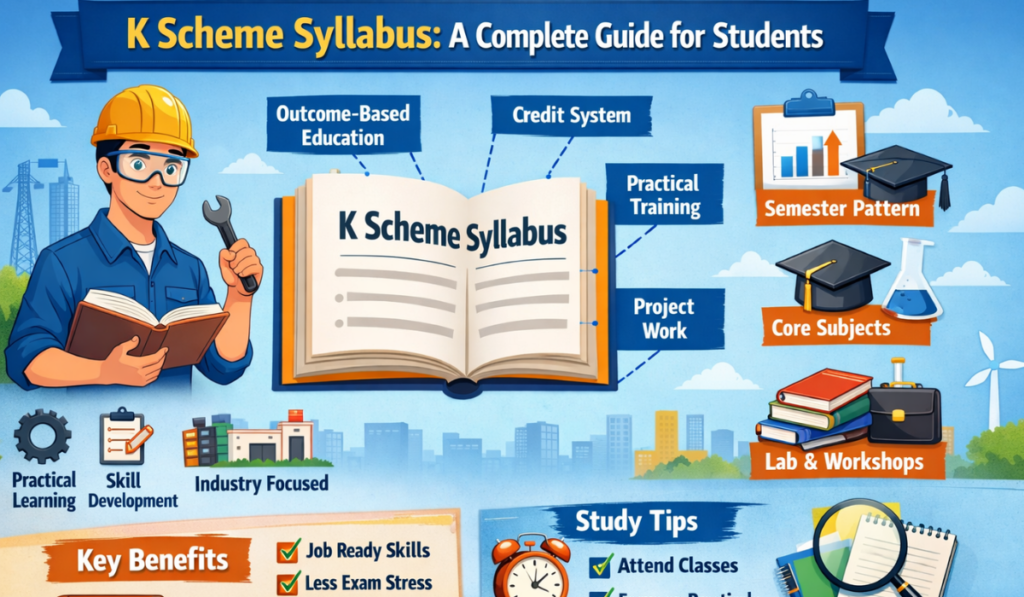
The k scheme syllabus is a new curriculum system based on the Diploma and Polytechnic courses. It is more about hands-on experience, real time experience and industry features and demand rather than just theory. In the past students were used to the normal syllabus in which theory subjects were more prevalent. However the k scheme syllabus reforms this approach and emphasis on:
- Practical learning
- Skill development
- Industry exposure
- Continuous assessment
Read More: PMFME Scheme (MOFPI) 2026: Subsidy, Benefits & Apply Guide
Benefits of K Scheme Syllabus
1. Skill Development
Students learn skills that will be applicable to actual jobs
2. Less Exam Stress
Less pressure-One final exam is not the be all and end all.
3. Better Job Opportunities
Subjects focused on the industry prepare the students for job readiness.
4. Practical Knowledge
Students do not learn by reading, but rather by doing.
5. Improved Confidence
It also helps in better communication skills during projects and presentations.
Purpose of K Scheme Syllabus Introduction
Many students were entering the fields of animal health care with little to no practical skills, and the education system really needed an overhaul. Industry required skill, but students were imparted mostly theoretical knowledge. In order to fix these issues, this scheme syllabus has been introduced. Top reasons to introduce k scheme syllabus:
- To make students job-ready
- To improve practical knowledge
- To reduce exam pressure
- To promote skill-based learning
- To match industry standards
With this new system, students are able to learn what is actually necessary in the real world.
Important Aspects of K Scheme Syllabus
1. Outcome-Based Education (OBE)
It is an outcome-based syllabus. This means that students need to demonstrate competencies that need to be achieved once the students are done with a certain subject.
2. Credit-Based System
Every subject has credits based on its significance. Must have credits to pass: Students have to do the needed credits in order to pass
3. Continuous Evaluation
Students are assessed throughout the semester instead of at the end with one final exam, using:
- Class tests
- Assignments
- Practical exams
- Projects
- Focus on Practical Learning
4. Industry-Oriented Subjects
Management institutes align subjects according to industry needs so that students can get jobs right after completing the course.
5. Structure of K Scheme Syllabus
This scheme syllabus is under a semestral course system. Each semester consists of some practical and some theoretical subjects.
Types of Subjects in K Scheme
1. Basic Subjects
- Mathematics
- Physics
- Communication Skills
2. Core Subjects
Core Specialization Subjects (Mechanical, Electrical, Civil, etc.)
3. Practical Subjects
- Lab work
- Workshops
4. Skill-Based Subjects
- Soft skills
- Computer applications
- Industrial training
5. Project Work
Real-life problem-solving projects This structure guarantees theoretical and practical knowledge for the students.
K Scheme Syllabus Semester Pattern

Example Semester Breakdown:
- 1st Semester: Core subjects + Introduction to engineering
- 2nd Sem: Fundamental + few core
- Terms = Core + Practicals (3rd Semester)
- 4th Semester: Advanced core courses + labs
- 5th Sem: Industry training + electives
- 6th Sem: Final yr project + mastering
Learning is progressive and forms the basis of the next semester.
Challenges of K Scheme Syllabus
This scheme syllabus opens many benefits to students; but then students also face some challenges.
1. Continuous Study Required
This means that students cannot just prepare overnight.
2. More Assignments
For some of the students, regular assignments may prove to be stressful.
3. Practical Focus
It may be a little tough for students who favour theory.
4. Time Management
Time Management – you need expert level time management skills to balance all the projects, exams, and practicals.
Comparison: K Scheme vs Old Scheme
| Feature | Old Scheme | K Scheme Syllabus |
| Focus | Theory | Practical + Skills |
| Exams | Final Exam Based | Continuous Assessment |
| Learning Style | Passive | Active Learning |
| Industry Relevance | Low | High |
| Stress Level | High | Moderate |
This scheme syllabus clearly provides a more modern and effective learning system.
How to Study Effectively in K Scheme Syllabus

1. Attend Classes Regularly
Do make sure to attend for internal marks.
2. Focus on Practicals
Free on lab work and projects – Do not let them get left unnoticed
3. Complete Assignments on Time
Since assignments are given marks, they should be treated seriously.
4. Revise Daily
Normal study assists with consistent evaluation.
5. Work on Projects Properly
Projects play an important role in final assessment.
K Scheme: How To Secure Marks
Some easy suggestions to help you achieve a better score in k scheme syllabus
- Understand concepts instead of memorizing
- Practice previous year questions
- Stay consistent in studies
- Ask doubts in class
- Prepare notes for revision
- The secret to success with this system is consistency.
- K Scheme Syllabus Enables Importance of Projects
Future Scope After K Scheme
Careers after this Syllabus under k scheme Students studying under this scheme syllabus have a number of career opportunities available to them.
Career Opportunities:
- Jobs in industries
- Higher education (B.Tech)
- Government jobs
- Entrepreneurship
Students learn to succeed in all professions, because of the practical skills this system teaches.
Common Mistakes Students Should Avoid
Mistakes to avoid when you are studying under the k scheme syllabus
- Ignoring internal assessments
- Skipping practical classes
- Studying only before exams
- Not completing assignments
- Avoiding projects
Conclusion
The k scheme Every single is a recent syllabus with distributing the idea of info contained in it and as a student-oriented education system with focus on practical learning and skill and industry readiness. It is intended to prepare candidates for real-life jobs rather than exams only. While it may take time and practice, it is worth all the output. The right students may find their way through this system while building the necessary skills, confidence and opportunities for better careers.
So if you are learning under the k scheme syllabus then study harder and continue this at least make the best use of this time. This system is more than just an examination system, this, my friends, is a system that lays the foundation for the future that you are going to build.
FAQs on K Scheme Syllabus
1. What is the k scheme syllabus in diploma?
This scheme syllabus is a skill-based curriculum for diploma students that focuses on practical learning and industry-relevant education.
2. What are the benefits of the k scheme syllabus?
It improves practical skills, reduces exam pressure, and prepares students for real-world jobs.
3. Is the k scheme syllabus difficult for students?
It is not difficult, but it requires regular study, practical work, and active participation.
4. How is the k scheme syllabus different from the old syllabus?
This scheme syllabus focuses more on practical knowledge, continuous assessment, and industry skills compared to theory-based old systems.
5. Does k scheme syllabus include practical exams?
Yes, practical exams and lab work are an important part of this scheme syllabus.
6. How can I score good marks in the k scheme syllabus?
Focus on understanding concepts, complete assignments on time, and practice practical work regularly.
7. Is the k scheme syllabus useful for jobs?
Yes, it is highly useful because it develops skills required by industries, increasing job opportunities.

