
Maternal health is one of the highest priorities of a strong and growing nation. Realising this, the Government of India has launched a welfare programme, Matru Vandana Yojana, to provide cash benefits and nutritional support to pregnant women and lactating mothers. The scheme targets maternal health, prevention of malnutrition and promotion of safe delivery practices for women from lower socio-economic status.
Details on the PM-Matru Vandana Yojana: Background and Purpose
Though India has achieved consistent improvement in Maternal and infant mortality, undernutrition, anaemia, and lack of access to health services persist. In order to curb these problems, the Government in 2017 introduced the Matru Vandana Yojana, which is a conditional cash transfer scheme. Its aim is two-fold: to pay women for lost wages due to pregnancy and post-partum, as well as to motivate them to receive medical visits on time.
It is a Central Sector Scheme, which means it is managed directly from the Centre, and the Government of India provides the corresponding funds for implementing the scheme from the Department of Women and Child Development. Synergising with the India-wide maternal and child health program, it brings services to the doorstep of the women.
Objectives of PM-Matru Vandana Yojana
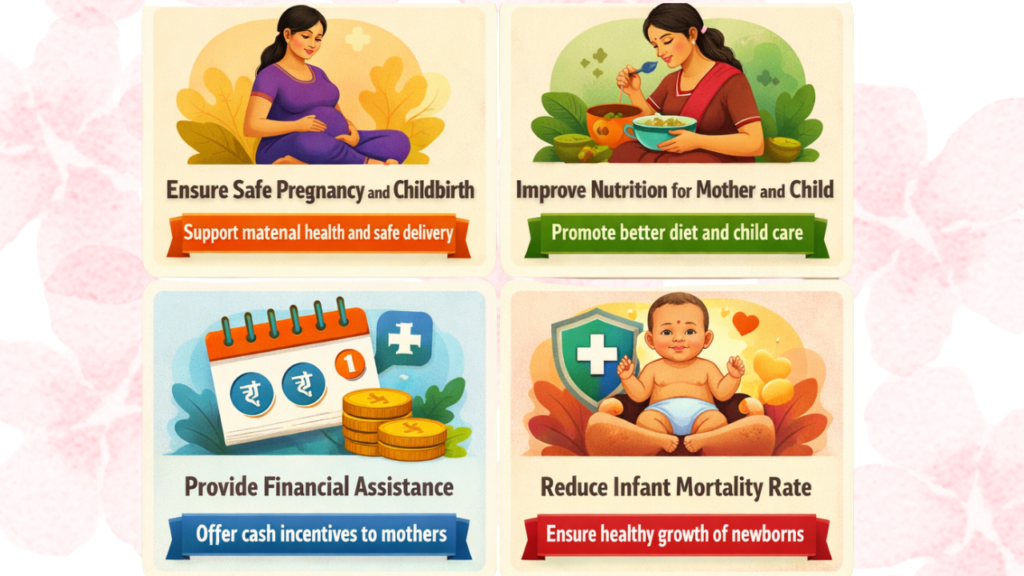
Matru Vandana Yojana has important components such as ensuring health-seeking behaviour of pregnant women and better nutrition during pregnancy, as well as during early motherhood. First-time mothers, in particular, could really benefit from this scheme, as it will take some of the pressure off their finances during this important time.
Another major aim is to encourage people to get institutional deliveries and regular antenatal check-ups. Under the scheme, women’s access to financial aid is linked to certain health problems, which incentivises women to go for medical tests, vaccinations and postnatal care that ultimately benefits the mother as well as the child.
Also read: Pradhan Mantri Garib Kalyan Anna Yojana.
Who is eligible for the PM-Matru Vandana Yojana in 2025?
There are minimum eligibility criteria that comply with the Matru Vandana Yojana to avail benefits. The scheme is mainly for pregnant women and nursing mothers above the age of 19 years. It is for the first live-born child in the family, which allows for essential support after having a baby.
Women have to register their pregnancy in one of the designated health centres or Anganwadi centres and undertake health checkups as per the recommendation. They are largely excluded so that there are no duplications from other Schemes, for example, for government employees and women who are getting the same maternity benefits from other schemes.
Below are the criteria for determining social and economic disadvantage:
- Scheduled Castes and Scheduled Tribes Women
- Women with partial disability (40%) or a full disability (Divyang Jan)
- Women with a BPL Ration Card
- PMJAY Beneficiaries under the Ayushman Bharat Programme
- Women with e-Shram cards
- Women farmers who are beneficiaries under the Kisan Samman Nidhi Programme
- Women with MGNREGA Job Cards
- Women with a net family income of under 8 lakh rupees per year
- Pregnant and/or lactating AWW / AWH / ASHA workers
- Women with NFSA Ration cards, as specified under the Act 2013 and all other categories as specified by the Central Government.
Who Is Not Eligible Under PM Matru Vandana Yojana
- The Aadhaar number of the beneficiary’s husband is not compulsory to receive benefits under the scheme.
- Pregnant women and lactating mothers employed regularly with the Central or State Government, or any Public Sector Undertaking (PSU), are not eligible for assistance under PMMVY.
- Women who are already availing maternity benefits under any other existing law or scheme are also excluded from receiving benefits under this program.
Step-by-Step Guide: How to Apply for PM- Matru Vandana Yojana Online
Visit: Go to the PMMVY Citizen Login page
Verify: Verify your mobile number by sending an OTP (One-Time Password).
Register: Register by providing your basic details (including your Name, District and Village)
Data Entry: After logging in, you should see a button to register as a beneficiary
Submit: Register for the Mother and Child Nutrition Scheme (for either your first or second child) by uploading your supporting documents.
List of Required Documents for Registration
To apply for this Scheme, the applicant must have:
- Mandatory Aadhaar Card.
- Aadhaar-linked bank account or Post Office account information.
- MCP/RCHI card (Mother and Child Protection Card).
- LMP & ANC Dates (Last Menstrual Period Date and Antenatal Check-Up Dates).
- Child’s Birth Certificate (Needed for the last Installment).
Women who qualify for the PM Matru Vandana Yojana (PMMVY) program.
- For women with an annual net family income of less than ₹8 lakh.
- For women in possession of a valid MGNREGA Job Card.
- For women who are farmers benefiting from the Kisan Samman Nidhi program.
- For women who have registered and obtained a valid e-Shram Card.
- For women beneficiaries covered under Pradhan Mantri Jan Aarogya Yojana (PMJAY) of Ayushman Bharat.
- For women who possess a ration card under the BPL (Below Poverty Line) program.
- For Divyang women who are partially (40%) or completely disabled.
- For Scheduled Caste (SC) and Scheduled Tribe (ST) women.
- For pregnant and lactating women employed as AWWs, AWHS, or ASHAs.
- For women beneficiaries who are in possession of an NFSA ration card (National Food Security Act), 2013.
All required documentation, including Aadhaar verification and Aadhaar-based Payment System, will be verified during the registration process for a smooth implementation of the program. It is mandatory to provide a mobile number to receive notifications about the status of applications and the disbursement of funds. A dedicated mobile application has also been developed for easy registration with PM Matru Vandana Yojana (PMMVY).
Financial Assistance and Benefits
The Matru Vandana Yojana provides eligible beneficiaries with funds in three stages during pregnancy and childbirth. The cash incentive is targeted towards nutrition and rest during pregnancy, as well as healthcare needs in postpartum.
The financial assistance through the Direct Benefit Transfer (DBT) system is directly credited to beneficiaries account. It promotes transparency, cuts down on delays and minimises the risk of leakages, and thus this scheme is more efficient and reliable.
| Stage | Milestone | Purpose |
| Installment 1 | Early registration of pregnancy | Nutritional support |
| Installment 2 | At least one Antenatal Check-up (ANC) | Monitoring health |
| Installment 3 | Child birth registration & first cycle of BCG, OPV, DPT | Infant health & vaccination |
Implementation Through Grassroots Networks
Hooking into the existing public health system is one of the strengths of the Matru Vandana Yojana. Beneficiaries identified, registered and health conditions complied by Anganwadi workers, Asha workers and local health officials.
They also work with women in terms of nutrition, breastfeeding, immunisation and family planning. They are the ones who prevent the scheme from being just an up-to-date gimmick for financial help, but instead a long-term behavioural change.
How Can This Help with Maternal and Child Health
But the Matru Vandana Yojana is more than just financial aid. The scheme promotes early reporting of pregnancy with regular antenatal health checkups that assist in early identification of health risk factors like anaemia or high blood pressure.
Better maternal nutrition leads to higher-birth-weight babies with a lower likelihood of complications. The scheme also encourages postnatal care that enables timely breastfeeding and immunisation, laying the base of a child’s growth on the right path.
Problems in the Implementation of Matru Vandana Yojana
While the Matru Vandana Yojana aims to do so with a politically powerful message to promote maternal health and help expectant women, there are many layers of implementation issues at the ground level. These impact awareness, access and timely delivery of benefits amongst sensitive populations.
1. Lack of Awareness
The primary difficulty in implementing the Matru Vandana Yojana is the awareness gap that exists, especially among eligible women in rural, tribal and remote areas. The enrollment is always low as a lot of beneficiaries often do not find out about the eligibility standards, registration processes or, for that matter, instalment and conditions laid out under the scheme.
2. Documentation and Registration Issues
Documents like Aadhaar, bank account and pregnancy registration numbers have to be uploaded under the scheme. This paper will give some unique insights into this method that were lacking from the public discourse around the Matru Vandana Yojana because the documents available from other states show a letter of recommendation from the bed welfare committee, which is really an outdated method to check eligibility of the family to get matru vandana yojana or individual check of every family in marginalised community where women do not have full-fledged documentation which delays/ stops the registration under Matru Vandana Yojana.
3. Delays in Benefit Disbursement
While the timely release of instalments is important, the administrative hiccups and verification bottlenecks on the ground slow down payments. In other cases, the timing of the disbursed funds is extreme to the extent that beneficiaries receive money not only for a few months but even for a few years after the intended point of pregnancy or postnatal stage, which reduces the effectiveness of Matru Vandana Yojana.
4. Digital and Banking Barriers
Matru Vandana Yojana is also dependent on DBT and a digital platform. But poor digital literacy, weak internet connections and lack of proper bank accounts often prevent the seamless transfer of funds, particularly in rural regions.
Government Initiatives to Reinforce the Initiative
In order to bridge these implementation gaps, the Government has initiated measures to expand outreach and enhance efficiency. Online registration and tracking of applications have been facilitated through digital portals. Field worker training programs for effective data collection of beneficiaries
In this regard, the scheme also ties into several other national initiatives related to nutrition and maternal health to provide a holistic support system for women. These are steps to make the Matru Vandana Yojana more comprehensive and efficient in all states.
Social and Economic Impact
The Matru Vandana Yojana not only enables women to keep health in the economic aspect, thanks to lesser financial pressure during pregnancy. This is critical support, especially for women in the informal sector who do not usually receive paid maternity leave.
Eventually, healthier mothers help lead to healthier families and communities. The scheme also strengthens attention to the national priority of women’s health by aiming for gender-appropriate development.
Conclusion
Matru Vandana Yojana is a much-needed step forward in the right direction to strengthen maternal and child health in the country. The scheme links conditional cash transfers, benefits, and health services with community-level delivery for the economic and health domains as they relate to pregnant women.
While there is scope for improvement in awareness and delivery mechanisms, the overall impact of the Matru Vandana Yojana has been positive. By continuing to refine and expand this initiative, India moves closer to ensuring safe motherhood and a healthier future for generations to come.
FAQ Matru Vandana Yojana
Q1. Is the husband’s Aadhaar mandatory?
NO, the husband’s Aadhaar is not mandatory to receive benefits.
Q2. Are government employees eligible?
No. Women employed by the Central/State Government or PSUs are excluded as they usually receive separate maternity benefits.
Q3. What is the amount of money provided under Matru Vandana Yojana?
Qualified recipients will get the incentive directly to their bank accounts, which is ₹5,000 altogether. The incentive is dispersed in instalments for each of the pregnancy and childbirth phases.
Q4. The payment to beneficiaries is done in what way?
It is directly deposited in the account of the beneficiary through the Direct Benefit Transfer (DBT) system.
Q5. Where does a woman register for Matru Vandana Yojana?
One can register through the nearest Anganwadi centre, from an authorised health facility, or via an online portal with the assistance of field workers.
Q6. Can every pregnancy be covered under Matru Vandana Yojana?
No, this scheme can be availed of only for the first child of the family.

