
India’s developmental aspirations can only be achieved with a strong, robust, and ready-to-go infrastructure framework. For many decades, infrastructure growth within the nation was plagued with impediments of inter-departmental coordination, delay in completion, cost overrun and possibly wasteful use of resources. In order to resolve these age-old issues, the Government of India has rolled out the PM Gati Shakti Yojana, a transformational initiative that is expected to change the conceptualisation, execution and coordination of infrastructure projects in the country.
Faster project delivery, this mission is an initiative to connect many ministries, state governments, and other stakeholders on the same digital platform. The scheme aims to streamline integrated planning and coordinated execution for boosting economic growth, enhancing logistics efficiency, and improving the ease of living for citizens. In the following article, we will listen to everything about the scheme, its objective, pillars, features, implementation strategy, and its long-term impact on India’s development journey.
What is new in the PM Gati Shakti Yojana
Introduced in 2021, this dynamic programme is a National Master Plan for Multi-modal Connectivity, designed to develop the Infrastructure in an integrated and holistic way as well as in a synchronised manner. The Emphasis is on integrating the different modes of transport, including road, rail, ports, airport, waterways, logistics infrastructure and digital connectivity.
In contrast to siloed infrastructure programs of the past, this initiative reveals how innovative computing approaches in digital mapping and data analytics can be employed to ensure alignment of projects from the planning stage onward. This mission aims to develop a single vision to avoid replication and delays and to utilise public funds effectively.
Background and Need for the Scheme
Logically, infrastructure development in India in the absence of the Gati Shakti Yojana by its nature will have been fragmented, out of sync; that is, planned and executed from now by silos, separate departments of the Central government undertaking development focused on and confined to government responsibility within silos. Independent planning of projects by various ministries led to conflict on the ground, such as newly constructed roads being dug up for utility line work or rail projects being delayed owing to land-use conflicts in states.
These inefficiencies resulted in:
- Increased project costs
- Delayed economic benefits
- Poor logistics performance
- Reduced investor confidence
This was thought of as a structural reform to bring together various departments to ensure there are no silos within the department. This was to address the above challenges that we face.
Key objectives of the PM Gati Shakti Yojana

- Integrated Infrastructure Development
Planned and coordinated across sectors; seamless execution of infrastructure projects
- Improved Logistics Efficiency
Multimodal Transport: Improving the functionality of multimodal transport to lower logistics costs and increase the efficiency of the supply chain
- Time-Bound Project Execution
Reducing delays with live monitors and better planning.
- Economic Growth and Job Creation
Infrastructural Development for Industrial Growth and Employment Attraction
- Improved Ease of Living and Business
Enhancing the experience of citizens and businesses with improved connectivity and services.
Also Read: Ladli Laxmi Yojana: Objectives
Key Pillars of PM Gati Shakti Yojana
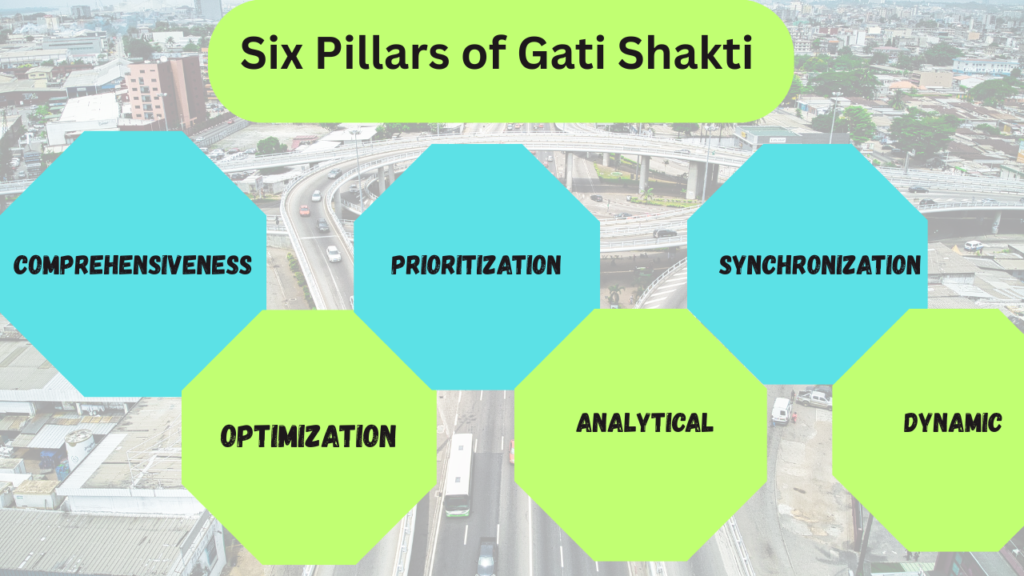
There are multiple key pillars and enablers that form the foundation of PM Gati Shakti Yojana and will ensure it is effective and scalable.
Multimodal Connectivity
The scheme is a combination of different transport modes, such as:
- Roads and highways
- Railways
- Ports and shipping
- Airports
- Inland waterways
The PM Gati Shakti Yojana integrates these modes holistically for the rapid and efficient movement of goods and people.
Digital Infrastructure Platform
The PM Gati Shakti Yojana has many unique characteristics and attractive promotions, one of which is for a GIS-based Digital platform. It aggregates data from various ministries to enable planners to see where planned projects overlap, compete, or have optimal routes, and visualise those before executing.
Inter-Ministerial Coordination
The scheme facilitates cooperation between central ministries, state governments and local governments. Coordination meetings regularly ensure that the infrastructure development stays in line with national priorities.
Focus on Last-Mile Connectivity
Under the PM Gati Shakti Yojana, Special Focus has also been placed on linking remote and unserved regions for inclusive growth.
Sectors Covered Under PM Gati Shakti Yojana
The PM Gati Shakti Yojana encapsulates several developmental sectors for India.
- Transport infrastructure
- Power and renewable energy
- Telecommunications
- Urban and rural infrastructure
- Industrial corridors
- Logistics parks
- Social infrastructure, like schools and hospitals
This wide scope allows development to be equitable and sustainable.
Role of Technology in PM Gati Shakti Yojana
Technology is at the centre of the success of the PM Gati Shakti Yojana. It leverages high-end tools that include
- Geographic Information Systems (GIS)
- Satellite imagery
- Real-time data analytics
These tools are meant to help decision-makers describe and assess bottlenecks, feasibility, and progress. This leads to the use of data-led planning of infrastructure, rather than planning it based on demand.
Implementation Strategy
PM Gati Shakti Yojana is implemented systematically and in a phased manner.
Central Government Role
The central government offers policy guidance, funding support, and technological infrastructure.
State Government Participation
The national master plan must serve as a guide for states to align their development plans with it so that seamless coordination will happen.
Private Sector Involvement
Investment and expertise to be mobilised through the mode of the Public-Private Partnership (PPP) under the PM Gati Shakti Yojana
Benefits of PM Gati Shakti Yojana
The scheme provides several advantages in diversity among different stakeholders.
Economic Benefits
- Faster infrastructure development
- Reduced logistics costs
- Increased competitiveness of Indian industries
Social Benefits
- Better access to essential services
- Improved regional connectivity
- Enhanced quality of life
Environmental Benefits
- Optimised routes reduce fuel consumption
- Planned development minimises environmental damage
Therefore, the PM Gati Shakti Yojana contributes to sustainable and inclusive growth.
Impact on Logistics and Supply Chain
As compared to global benchmarks, logistics costs have historically been higher in India. This problem is solved by way of the PM Gati Shakti Yojana.
- Promoting multimodal transport
- Developing integrated logistics hubs
- Reducing transit times
All these reforms enhance India as a global manufacturing and export destination.
Gati Shakti Yojana and Ease of Doing Business
The PM Gati Shakti Yojana, to provide for improved reliability of infrastructure and reduced uncertainty, adds significantly to the ease of doing business. Businesses benefit from:
- Faster project approvals
- Predictable timelines
- Improved market access
This makes the local atmosphere appealing to both local and foreign investors.
Challenges and Limitations
PM Gati Shakti Yojana has a very ambitious vision, but is challenged by some factors as follows:
- Data integration across departments
- Building capacity at the state and local levels
- Timely adoption of digital tools
- In order to mitigate these challenges, ongoing monitoring, training, and policy support are needed.
How do States has an Role in PM Gati Shakti Yojana
The role that state governments can play in ensuring the success of the PM Gati Shakti Yojana is pivotal. States can align state-level projects to the national master planAutomatically.
- Avoid duplication of efforts.
- Maximise funding efficiency
- Accelerate regional development
- Many states have already started incorporating aspects of their infrastructure plans into its construct.
The PM Gati Shakti Yojana, which has a long-term vision
The PM Gati Shakti Yojana envisions providing a solid structure for the Indian economy in the coming decades. Such an integrated infrastructure framework is envisioned to transform India by 2047, the year India plans to be a developed nation.
Comparison with Previous Infrastructure Initiatives
The PM Gati Shakti Yojana is a project targeting convergence and coordination, unlike the earlier programs, which were different for each sector. This all-inclusive outlook is a notable departure from the existing infrastructure planning and policy- making philosophy of India.
Future Prospects
With the increase in the uptake of digital platforms by other ministries and states, the actual utility of the PM Gati Shakti Yojana is bound to be enhanced. Regular updates, improved data accuracy and involvement of stakeholders will, even more, fortify the initiative.
Conclusion
This mission is part of the new thinking in India about infrastructure development. The scheme solves problems that have prevented growth in the past by combining planning with the use of technology and bottom-up organisational involvement.
The PM Gati Shakti Yojana is more than an infrastructure programme as it aims to transform the country with its emphasis on multimodal connectivity, timely logistics, and sustainable development of resources. Its implementation can reshape the economic environment that India finds itself inhabiting, providing its ongoing growth a course into steady-state development.
FAQ
Q1. What is PM Gati Shakti Yojana?
It is a national master plan for integrated multimodal infrastructure development in India.
Q2. When PM Gati Shakti Yojana launched?
The Government of India launched it in the month of October 2021.
Q3. What is the main objective of the PM Gati Shakti Yojana?
It aims to facilitate coordinated planning and, thereby, quicker implementation of infrastructure projects.
Q4. What all are the sectors included in the PM Gati Shakti Yojana?
Roads, railways, ports, airports, logistics, Power, and social infrastructure
Q5. What role of PM Gati Shakti Yojana play in logistics?
Improved multimodal connectivity and supply chains, in turn,n lowers logistics costs.
Q6. Who is the implementing agency of the PM Gati Shakti Yojana?
It is implemented jointly by the Central ministries & State Governments and the Footwear and Leather Goods Industry (Private sector).

