
The PM Solar Scheme is among the best available options in India if you want to pay less on electricity and also use clean energy. It is a government scheme that assists citizens to fix solar panels on the roofs at a reduced price with the help of financial help. Through this long read blog, you will understand all about the PM solar scheme in easiest language- benefits, features, applying process, FAQs.
What is the PM Solar Scheme?
The pm solar scheme is a central government initiative to promote solar panels on rooftops. Its aim is to decrease electricity bills, encourage renewable energy, and to make India more energy independent. Under this plan, individuals can obtain electricity from the sun themselves. Through the subsidies of the government the installation cost is decreased and solar power is much more viable for common people.
Under the PM Surya Ghar: Muft Bijli Yojana, this scheme provides free electricity to the prospect of usage by harnessing solar energy.
Overview Table of PM Solar Scheme
| Feature | Details |
| Scheme Name | PM Solar Scheme (PM Surya Ghar Yojana) |
| Launched By | Government of India |
| Target Beneficiaries | Indian households |
| Objective | Promote rooftop solar energy |
| Subsidy | Up to 40% (depending on capacity) |
| Installation Type | Rooftop Solar Panels |
| Application Mode | Online |
| Official Portal | National Solar Portal |
| Electricity Benefit | Reduced or zero electricity bill |
Key Features of PM Solar Scheme
1. Rooftop Solar Installation
The Deen Dayal scheme aims to set up solar panels on rooftops of houses. This allows establishing already available capacity without the need for additional land.
Rooftop systems are suitable for urban and countryside homes and it produces sufficient electricity for daily consumption.
2. Subsidy-Based Model
The beneficiaries receive money directly through the government subsidy. With this, the investment needed for solar installation is lower.
The amount varies depending on the size of the system, and is provided as a rebate after installation and inspection.
3. Easy Online Application
Users can apply for a solar scheme via an online portal. This simplifies and clarifies the procedure.
Online tracking of application status and approvals by recipients
4. Net Metering Facility
This means that users can send surplus energy back to the grid. In return, they are issued bill credits on their electricity bill.
Its usefulness is definitely at its peak in harnessing solar energy,
5. Suitable for All Households
It is a scheme for the benefit of middle class and lower class families. It’s open to anyone who has a suitable rooftop!
So whether you live alone, or are a family of four, it’s designed for you.
6. Long-Term Durability
The panels installed through the programme are high-quality ones and have a lifespan of decades.
They offer stable performance while requiring little maintenance.
7. Promotes Clean Energy Mission
It supports India’s ambition to increase the share of renewable energy to achieve its nationally determined contributions. The main role is in fossil fuel independence.
Benefits of PM Solar Scheme
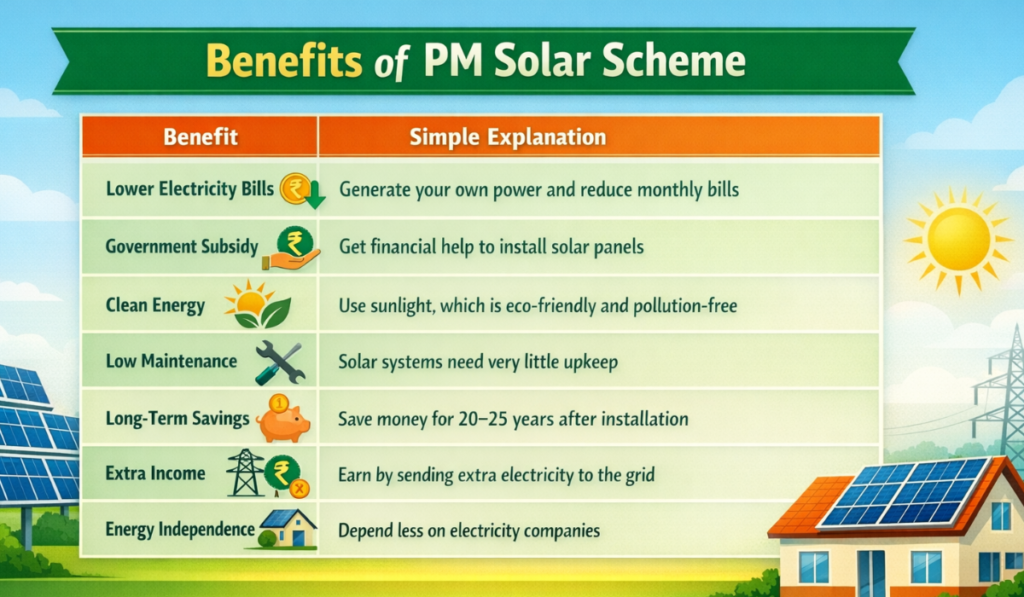
1. Huge Savings on Electricity Bills
The pm solar scheme is one of the best ways to save your electricity bill. By installing your solar panels, you can produce your own electricity with less reliance on the grid. Many households can even attain no charge at all in situations of low power usage.
2. Government Subsidy Support
Subsidies: A financial assistance provided by the government This also cuts down on the upfront expense of putting solar panels up. 16 of these cover small systems (1-3 kW) with up to 40% subsidy making solar very cheap.
3. Environment-Friendly Energy
Solar power is free and non-polluting. Using solar panels is a way to keep nature safe by lowering carbon emissions.
It is also a significant milestone in becoming more eco-friendly.
4. Low Maintenance Cost
Solar Panels Maintenance Cost: Solar panels need almost no maintenance. If properly installed, they require very little maintenance and can last for up to 20–25 years. This gives it a life of many years and makes it a very economical choice.
5. Extra Income Opportunity
Sometimes, when your system generates an excess of power than you are using, you can export the spare electricity to the grid which can fetch you credits or cash. It’s called net metering, actually.
6. Energy Independence
By using solar panels, you will not rely much on electricity companies. You can produce your electricity and stop hearing about rising prices every year.
7. Increase in Property Value
Homes with solar panels are more attractive to buyers, and they tend to have higher resale value.
Read More:Lakhpati Didi Scheme: Full Details|Senior Citizen Saving Scheme (2026)|Agnipath Scheme: Complete Guide, Eligibility & How to Apply|PM Internship Scheme 2026: Complete Guide
Process of PM Solar Scheme
The process of getting benefits under the pm solar scheme is simple and user-friendly.
- Registration – You need to register on the official portal.
- Feasibility Check – Authorities check whether your rooftop is suitable.
- Vendor Selection – Choose an approved solar vendor.
- Installation – Solar panels are installed at your home.
- Inspection – Government officials verify the installation.
- Subsidy Transfer – Subsidy amount is transferred to your bank account.
How to Apply for PM Solar Scheme (Step-by-Step)
Applying for the pm solar scheme is easy if you follow these steps:
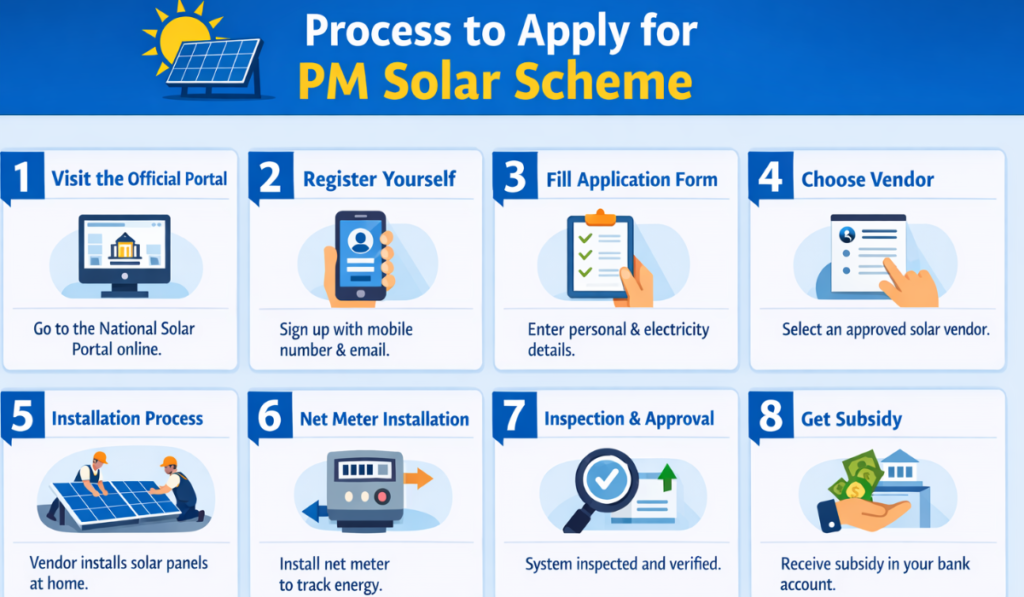
Step-1: Go To The Official Portal
Visit the National Solar Portal of the Ministry of New & Renewable Energy, Government of India. It is your starting point of the application procedure online. Use the proper and secure website
Step 2: Register Yourself
Sign up with your mobile number and email ID. You will also have to provide your electricity consumer number. You can log in at any time after signing up.
Step 3: Fill Application Form
Go ahead and carefully fill in your particulars and address. Input details about your electricity consumption and rooftop space. Double-check all information before submitting the form.
Step 4: Choose Vendor
Choose a vendor from a list of approved solar companies. So make sure you compare services and prices before selecting a service. This provider will take care of your installation process.
Step 5: Installation Process
The vendor you choose will install solar panels at your home.
They will follow all the setups and safety standards. Installation: A few days max to install.
Step 6: Net Meter Installation
An energy meter is placed there to monitor the usage of electricity. The extra energy fed back to the grid is also measured here. This also leads to lower electricity bills.
Step 7: Inspection and Approval
Government inspectors will be checking your installed systems. They just make sure everything works.
Once it is verified, it is approved by your system.
Step 8: Get Subsidy
After your subsidy is approved, you will proceed with your subsidy process. The money is sent directly to your bank account. This lowers the installation cost as a whole for you.
Conclusion
It is a strong initiative on the larger aspects of growth towards a bright and green future by the pm solar scheme. This will save you money as well as contributing to clean energy and environmentally friendly. This scheme is suitable for all households where they want to reduce their electricity bills and want to go to energy independence because of easy application, government subsidies and long run benefits associated with it. If you are planning to install solar energy, book the pm solar scheme as it is the perfect time to experience sustainable living for decades to come.
FAQs About PM Solar Scheme
Q1. What is the PM Solar Scheme?
The PM solar scheme is a scheme by the government in which they provide subsidies to people for installing solar panels on rooftops for the electricity cost.
Q2. What is the eligibility criteria for the PM Solar Scheme?
Anyone who has a rooftop of their own and a valid electricity connection can apply.
Q3. What is the subsidy offered under the PM Solar Scheme?
Depending on capacity and guidelines issued by the government, the subsidy can be as high as 40% for smaller systems.
Q4. Is the PM Solar Scheme free of cost at all?
The scheme isn’t entirely cost-free but it provides considerable financial backing which brings down the cost significantly.
Q5. Expected Lifespan of Solar Panels
Solar panels require almost zero maintenance and last for a 20-25 year lifespan.
Q6. Should I Invest in Solar Panels to Make Money?
Net metering allows you to earn credits when you send surplus electricity to the grid.
Q7. PM Solar Scheme Online Registration 2023 [How to Apply PM Solar Scheme Online?
It can be availed by applying through the government solar portal where you have to register the application, and fill in the details.

