
This blog is all you need to get a complete clarity on Sukanya Samriddhi Yojana — Sukanya Samriddhi Yojana age limit, Sukanya Samriddhi Yojana benefits, Sukanya Samriddhi Yojana Interest Rate, Sukanya Samriddhi Yojana eligibility criteria, Sukanya Samriddhi Yojana documents required, Sukanya Samriddhi Yojana Online & Offline apply. This complete guide will help you decide well if you are planning to go with an option where you can save for future for your daughter, and looking for a safe and government supported option to save for your daughter. In this article, let us understand about this scheme and how it can help you create a solid financial corpus for your girl child education and other future requirements.
What Is Sukanya Samriddhi Yojana?
Sukanya Samriddhi Yojana is a government-supported saving program specifically designed to provide India citizens with a savings mechanism toward the future of a girl child. Introduced as a part of the Beti Bachao, Beti Padhao scheme, for every daughter, parents or guardians can open one account in the name of the daughter and start saving systematically. SSY aims to provide a girl with the funds to pursue higher education, and get married, giving shape to her dreams without the restraints of money being a limit.
This scheme is compelling for offering guaranteed returns, competitive interest rates, and attractive tax benefits under Section 80C, as well as tax-exempt interest and maturity proceeds. The ability of SSY to build a sizable corpus over a long horizon, coupled with the magic of annual compounding, go a long way to inculcate a culture of regular saving among families. It is not just a financial product, it is security, empowerment and a vision that every daughter deserves to pursue her dreams without financial worries.
Why SSY Truly Matters?
Now before we jump on the numbers and rules, let us dwell for a second what is securing a daughters future in an Indian household actually meant by. For millions of families, it means allowing her to go to college and graduate debt-free, enabling her to chase her full potential without worrying how she will pay for it, and removing all additional stress during key moments in life such as graduation or marriage. That’s also strengthening the belief that she is never an expense, but rather an asset, a treasure, always capable and so valuable.
Benefits of Sukanya Samriddhi Yojana
Sukanya Samriddhi Yojana carefully crystallise the emotional aspirations and angst, into a sincere and disciplined roadmap for a financials, one that grow patiently year after year, and deliver not merely returns on investment to the parents, but true peace of mind.
Sukanya Samriddhi Yojana is more than a savings plan, it is a long-term financial security order forged to protect a girl child. The plan provides several advantages, which is why it is among the most preferred and lucrative investment options for parents in India. Here are the key benefits:
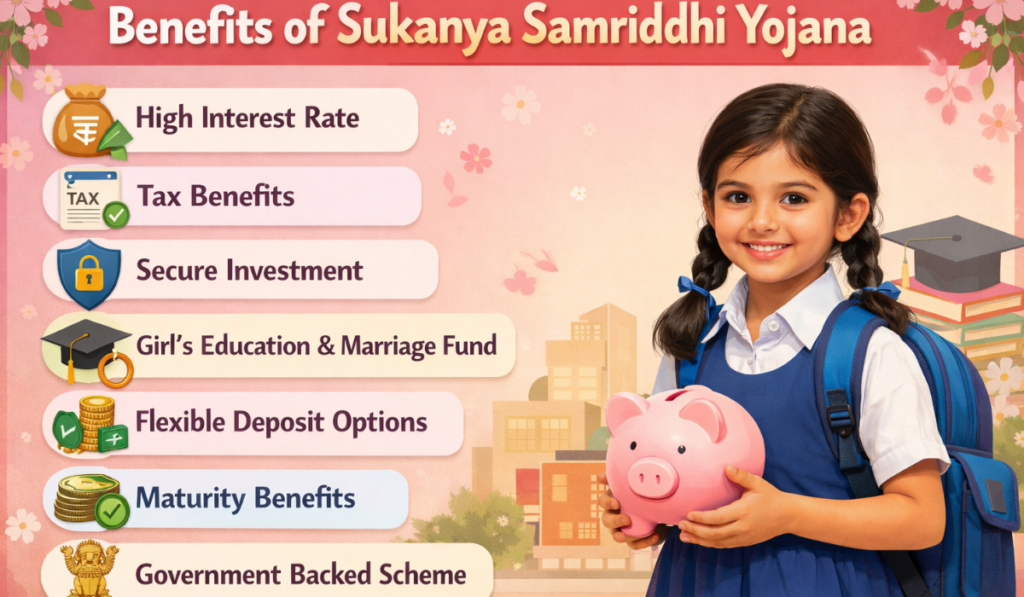
High Interest Rate
Comparative interest rate returns with regular saving accounts and many fixed income schemes- While SSY comes with a compounding interest rate payout option which SSY will be earning, it is definitely on a higher note than any of the regular savings account options and thus brings you the amount in multiple numbers through compound. Here, the interest is compounded once in a year, which leads to a higher maturity amount in the long run.
Government-Backed Security
There is a very low risk as SSY is backed by the Government of India. 4.Agent-based investment Creating such an investment is a long-term option that is not affected by any market fluctuations due to uncertainty, so it can be said that parents can invest in such an efficient investment without fear of chaos in the market.
Triple Tax Benefit (EEE Status)
The scheme is EEE (Exempt — Exempt — Exempt) tax status. A PPF Account can be opened with a minimum investment of ₹ 500 to a maximum of ₹1,50,000 a year, and qualifies for a deduction under Section 80C, the interest earned is tax-free, the maturity amount is also tax-free in full.
Long-Term Wealth Creation
The scheme features a maturity of 21 years and only requires you to deposit money for 15 years which helps your wealth grow through the power of compounding giving you a huge corpus for marriage or higher education.
Low Minimum Investment
With a minimum annual deposit of ₹250, the scheme is within access of families with all financial capabilities. Small amounts can mean great savings over time.
Partial Withdrawal for Education
During the vital academic years, the balance up to 50% can be withdrawn after the girl reaches 18 years of age for her higher education.
Encourages Early Financial Planning
Saving early also allows parents to instill a disciplined savings habit. This can help prevent future financial stress and make large expenses less of a surprise.
Transfer Facility Across India
In case of a family moving to another place, the SSY account is completely transferable from one bank or post office to another in India to avoid any disruption in the savings process.
Empowerment of the Girl Child
SSY represents more than a mechanism for financial profits, it is a vehicle for empowerment. It helps raise a daughter with the assurance that her education and future ambitions (to whichever extent works with the daughter) are financially secure.
Now on the whole Sukanya Samriddhi Yojana is a package of safety with higher returns, income tax exemption benefits and emotional security. It’s more than just an investment plan— it’s a deliberate pledge to empower every girl child with confidence to build a financially secure future for themselves.
Sukanya Samriddhi Yojana: Who can Apply (Eligibility Criteria)
Before applying, parents should be aware of the sukanya samriddhi yojana age limit —one of the most crucial eligibility criteria. A girl child can open an account anytime from the birth to the age of 10-year and hence opening at early stage is beneficial for long run. This scheme does require that the child is a resident Indian, that only one account per girl can be opened and that there can be a maximum of two accounts per family (not including twins or triplets), barring the sukanya samriddhi yojana age limit of course.
The eligibility rules under Sukanya samriddhi yojana are straightforward:
Age Limit: At the time of opening account, Girl child should be below 10 years of age.
Who Can Open: The account is opened and managed by a parent or legal guardian.
Rule for One Account: One SSY account can only be opened for one girl child.
No. of Accounts: Up to 2 accounts per family (daughters only)
Note: In case of twin/triplet girls, more than two accounts permitted (with proof).
Residence: The girl child must be a resident of India.
What Documents are Required: Girl child: Birth certificate Parent/guardian: ID and address proof
These uncomplicated criteria guarantee actual households are obtaining the advantages of the scheme, and assist the protection of the future of every now and again eligible girl child.
Maturity Age & Maturity Period Of Sukanya Sukanya Samriddhi Yojana (SSY )
The scheme to be implemented under Sukanya Samriddhi Yojana scheme is to give long term savings account for the financial needs of a girl child to give money at important phases of her life. Here are the age and duration rules in a nutshell.
Account Opening Age: This account can be opened at any time between the birth of the girl child and when she turns 10 years old. The earlier they open up the more time the money compound interest will grow.
Deposit Period (15 Years Rule): Parents or guardians are required to make deposits for 15 years from the account opening date. The account requires no additional deposits after the initial 15 years, but continues earning interest until maturity.
Maturity Period (21 Years Rule): The account has a maturity period of 21 years from the date of the account opening and not from her birth. At maturity, the total amount (principal + interest) is given to the holder.
Interest After Deposit Period: The invested money can continue to gain interest until 21 years, after 15 years the deposit period is also over.
Early Closure for Marriage: Also, if the girl gets married after turning 18 years, then this account can be closed prematurely. This may need evidence of your age and relation to be held to support for marriage.
Partial Withdrawal Option: Withdraw up to 50% of the balance for post-secondary education expenses, once the girl is 18 years old.
Extension After Maturity (If Needed):In some cases, the amount may earn interest according to the current rules if not withdrawn immediately after 21 years.
The biggest advantage of SSY is its long time period. Not only does it promote savings and discipline in the years leading up to independence, but it also ensures your daughter walks into adulthood with confidence and security in regard to her finances.
Sukanya Samriddhi Yojana Online Apply Process Step by Step
Step 1: Go to the designated bank or post office: One can avail the SSY account in any public or private sector bank branch or even at your nearest post office. This option is available with the majority of major banks operating in India. Before that, preferably select a branch which you would visit sometimes for the updates or queries.
Step2: Collect the Application Form: Request for a Sukanya Samriddhi Yojana Account Opening form from the counter of the bank. A few banks even allow downloading of the form from the bank’s official website. Make sure you read the instructions before completing it.
Step3: Fill in Required Details: Provide the correct information like the girl child name, DOB, parent/guardian details, address, and contact information. Go into the proper detail of your resume, double-check spellings, dates, and make sure to avoid future complications.
Step4: Attach Necessary Documents: Age of the girl child (submit birth certificate as proof of age) Identity & address proof of the parent or guardian (Aadhaar card, PAN card, passport or voter ID) be included as well. You may also need passport-sized photos.
Step5: Make the Initial Deposit: Make a small fund deposit of ₹250 to start some activity, the chances of your account getting activated. You can, however, deposit a higher amount, subject to your financial comfort up to ₹1.5 lakh per financial year. This deposit can be made in cash or cheque or digital mode based on the institution.
Step6: Receive Passbook / Account Confirmation: A passbook or some sort of official confirmation will always be given to you after they confidently confirm your credentials. A passbook is a booklet containing details of an account including account number and date of opening with transactions if any. Save it for later.
Step7: Online Application Option (If Available): Most of the banks also allow you to open and manage your SSY accounts via net banking or mobile banking. If so, then you can sign in, choose government schemes, enter the details, upload the documents and transfer the first deposit digitally, if your bank offers this facility.
With these steps, guardians can protect their daughter’s wealth in one appointment or a few clicks of the mouse. It is intended to be simple and transparent and for this reason, open to families all over India.
Read More: PM Kisan Samman Nidhi Scheme
How Much Can You Invest? (Deposit Rules)
The deposit structure under Sukanya Samriddhi Yojana is flexible to ensure participation by families belonging to different income levels. Following are the detailed rules explained in a clear manner with bulleted points −
Minimum Annual Deposit – ₹250:
An account should have at least ₹250 deposited in a financial year to remain active. This very low minimum level means that families on average incomes can begin saving for their daughter, without needing to stretch their budget.
Maximum Annual Deposit – ₹1,50,000:
You can open one account in SSY, under your single name, in which you can invest maximum amount of ₹1.5 lakh in the financial year. The maximum limit is particularly useful for parents who wish to create a bigger corpus and want to avail total tax benefits under Section 80C.
Deposit Flexibility:
There is no limitation to the quantity of money you put within a 12 months. Monthly, quarterly or one-time deposit — whatever suits you best — as long as you are not crossing the limit of ₹1.5 lakh in a financial year
Commonly deposit tenure 15 Years Only:
It has a period of only 15 years in which you need to make deposits starting from the date of opening the account. You will not need to invest beyond the initial 15 years but the account will keep earning interest till it is 21 years.
Penalty for Missing Minimum Deposit:
If you do not deposit a minimum of ₹250 in any financial year, the account is classified as in-active. But, it can be restored by just paying a nominal penalty of ₹50 for every year of default and the prescribed minimum deposit.
Mode of Payment:
These deposits can be done in cash, through cheque or demand draft or as digital mode of transfer depending on whether the investments are being made via bank or through post office facilities.
No Backdated Bulk Deposits:
You cannot catch up on years you missed by putting in huge deposits later (over the annual cap). There are different minimums and maximums per year.
Interest Calculation Benefit:
You have higher potential to earn interest if you deposit earlier in the financial year because interest is calculated on the lower of the balance between the 5th and the last day of the month (current rules).
The flexible deposit rules make SSY a practical and accessible product. The plan encourages disciplined savings, so whether you want to invest small amounts, regularly or deposit a lump sum annually, you can make that happen while creating a wonderful financial platform for your Daughter.
People also ask
1. Is it possible to get the money out before the end of the term?
Yes. On the occasion of the girl being 18 years old, 50% of the account balance can be withdrawn to pay for the higher or marriage on certain conditions that have been fulfilled.
2.Is Sukanya Samriddhi Yojana tax-free?
Yes. Triple taxation advantage (EEE status) on SSY — one gets a deduction for investment in SSY under section 80C, interest is tax-free and the maturity amount is also fully tax-free.
3.What is the maximum amount to deposit every year in Sukanya Samriddhi Yojana (SSY)?
The parents or guardians will have to deposit a minimum of ₹250 per year and a maximum of ₹1.5 lakh within a financial year. You can deposit in installments over the year.
4.Sukanya Samriddhi Yojana Account Age Limit
This account can be opened for a girl child only in the past birth until the age of 10 years. No new account can be opened for over 10 years (Only in special cases, the government announced).
5.How much time does Sukanya Samriddhi Yojana have to be matured?
Amount of time to maturity of the SSY account: The SSY account will mature 21 years from the day it is opened. Nonetheless, only the first 15 years are subject to deposits and the account accrues interest to maturity.

